Author: CAHNR Communications

Seeking Research Participants: OEHS Professionals Perceptions Study

Employer and Occupational and Environmental Health and Safety (OEHS) Professionals Perceptions Study

The Korey Stringer Institute is seeking employers and OEHS professionals to participate in a research study to understand the perceptions of employers and OEHS professionals regarding the employment of athletic trainers in the occupational setting. The time commitment will be 1.5 hours and participants will be compensated.

You are eligible to participate if you meet the following criteria:

  • Over the age of 18
  • Currently employed as a non-medical, OEHS professional or employer (i.e. environmental health and safety manager, safety manager, industrial hygienist, CEO, or owner, etc.)
  • Currently have an athletic trainer employed at their place of work
  • Can speak English fluently
  • Have access to a phone or computer for the interview

Interested? Contact Cecilia Kaufman at cecilia.kaufman@uconn.edu.
Korey Stringer Institute Summer Fellowship Program 

The Korey Stringer Institute seeks talented undergraduate and graduate athletic training students to apply for an 8-week research and advocacy fellowship. This fellowship will be hosted at the University of Connecticut in Storrs, CT.  

This fellowship program is devoted to providing students exposure to high-level research, advocacy and education initiatives. Individuals will be provided full immersion into the daily operations of an active research lab; assisting with field studies, epidemiological investigations and laboratory protocols. Fellows will also assist KSI with advocacy initiatives and educational efforts focused on preventing sudden death in sport and physical activity at the local, state and national level.   

Candidates will be selected based on the strength of their application and desire to pursue a career field related to preventing sudden death in sport and the physically active. Successful candidates will demonstrate academic excellence, quality recommendations and strong communication skills. 


Number of Fellowships: 1 Fellow will be selected for Summer 2026 

Fellowship Amount: Up to a $4,000.00 stipend paid on a bi-weekly basis directly to the Fellow 

Fellowship Term: 8-weeks beginning in June 2026 

Fellowship Housing: If selected, Fellow is responsible for acquiring housing for the 8-week period 

Application Deadline: March 15, 2026, at 11:59pm EST.  


Eligibility: 

  • Undergraduate junior/senior level athletic training students currently enrolled in a CAATE-accredited program 
  • Graduate-level athletic training students currently enrolled in a CAATE-accredited program 
  • Certified athletic trainers currently enrolled in graduate school 
  • U.S. Citizenship OR appropriate work visa 


Required Materials:  

  • Cover Letter 
  • Resume (Including research, advocacy efforts/interests, and/or clinical experiences) 
  • 3 letters of recommendation.  
  • Transcript verifying eligibility. May be an unofficial transcript.  


Please send all completed applications to: 

Nia McBride 

Scientist of Occupational Safety, Korey Stringer Institute 

Email: nia.mcbride@uconn.edu  


For any additional questions, please email Nia McBride (contact information above) 


The First-Time Marathoner’s Guide to Fuel and Hydration for Your Marathon Training

First-time marathoners, if your training program is overwhelming you (and, if you’re anything like I was during training for my first 26.2, it is), I’m here to make one particular part of your marathon journey significantly less complicated and confusing: fuel. Specifically how to go about it when your runs get long.

When training for a marathon, people tend to focus on (and stress about) the obvious: running long and often. However, an overlooked—yet super important—component of crossing the finish line and staying healthy throughout your entire training cycle is midrun nutrition.

For some, it might seem simple: Can’t I just chomp down on half a banana during a long run? For others, it might be confusing: Is eating lots of sugar OK? What about GI issues, cramping, or bloating?

Use this as your guide to eating and drinking on the run, which is necessary for anyone training for a marathon. From gels to chews, hydration tabs to caffeine, here’s the deal, not only with what to consume while running, but why it’s one of the most important things to think about when it comes to crossing the finish line. Continue reading

Heat is killing more people than ever. Scientists are looking for ways to lower the risk

“It’s 5 a.m. and still dark at the Carlton Complex fire camp in central Washington, except for the fire’s orange glow on a distant ridgeline. Wildlands firefighter Bre Orcasitas, two colleagues, and three volunteers suit up: heavy duty fire-resistant pants, shirt, jacket, and helmet. Their boots weigh 2 kilograms; the backpacks they will haul to the fire—loaded with 6 liters of water, food for a 16-hour shift, safety gear, and hand tools—can weigh 30 kilograms. Sometimes the burden includes a 12-kilogram chain saw.

Read the full article at ScienceMag.org

The Smart Heart Sports Coalition Announced by the NFL

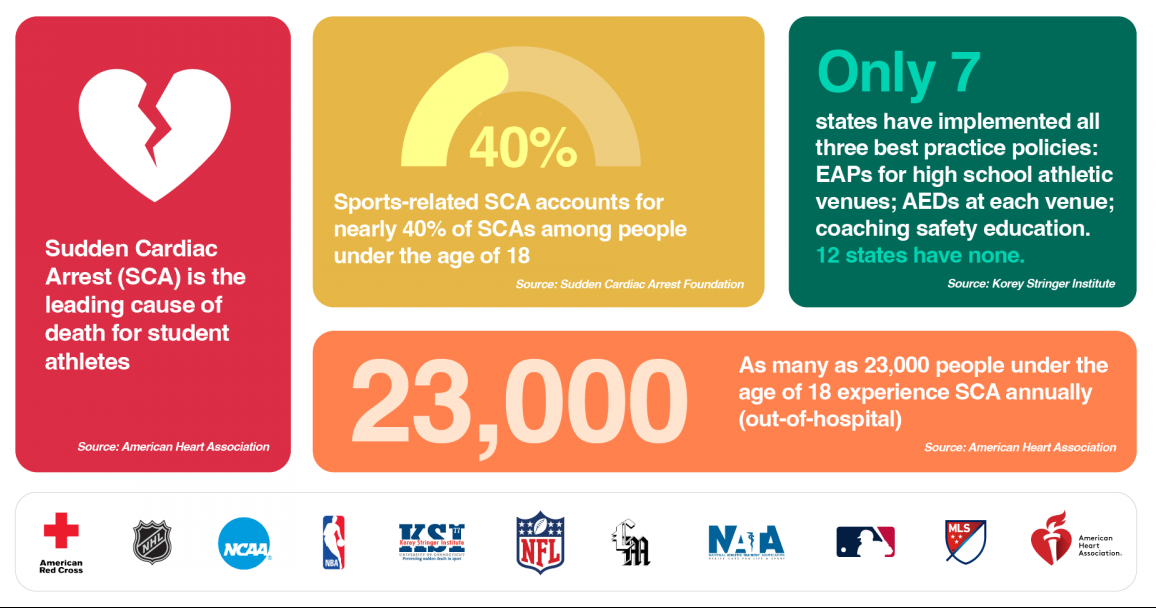
Infographic with the following informationSudden Cardiac Arrest (SCA) is the leading cause of death for student athletes. Sports-related SCA accounts for nearly 40% of SCAs among people under the age of 18. Only seven stateshave implemented all three best practice policies: EAPs for high school athletic venues; AEDs at each venue; coaching safety education. Twelve states have none. As many as 23,000 people under the age of 18 experience SCA annually (out-of-hospital).

Sources: American Heart Association, Sudden Cardiac Arrest Foundation, Korey Stringer Institute